Most “Tesla ownership cost” articles are built from estimates and averages. This one is built from my invoices.
I bought a used 2017 Model X 100D and have been driving it for years, logging every repair — first because I had to, then because I was building a monitoring system around the data. Below is what it has actually cost, item by item, with the real numbers. Where I quote community figures for context, they’re sourced. Where I quote my own bill, it’s my own bill.
If you’re deciding whether to buy one, or you already own one and want to know what’s coming, this is the honest version.
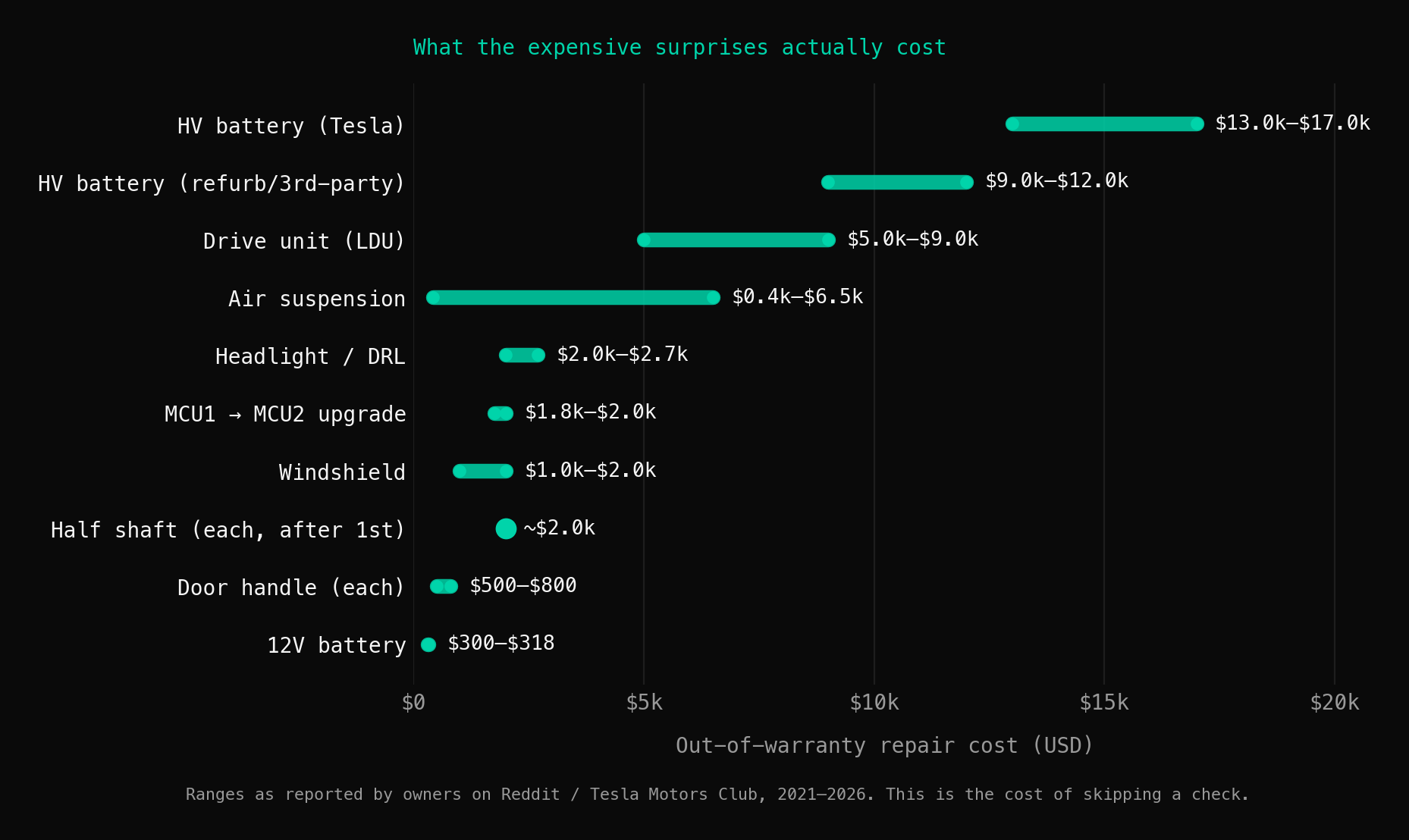
The two-number problem
Ask “what does a Model X cost to run?” in any Tesla forum and you’ll get two answers that are both true:
“Our 2017 with 125k on it has been perfect. Tires only.” — r/TeslaModelX
“I have 42k miles on my 2017 X and in the last 6 months have paid about $4,000 in repairs.” — r/TeslaLounge
Same car, same year. The difference isn’t luck — it’s configuration, history, and how the previous owner treated it. My car has been closer to the second story, and I’ll show you exactly why and where the money went.
The wear items (what you’re really buying)
These are the repairs that come with the territory on a 2016–2018 Model X. None of them was a surprise to the Tesla community; all of them were a surprise to me at the time, because nobody hands you this list when you buy the car.
- Front air struts — $5,612. Both were leaking. Air suspension is the known weak point on this generation, and by the time a corner visibly sags, the spring has been losing pressure for weeks. (More on catching that early below.)
- Both headlights — $7,536. Internal faults in both units. Legacy S/X headlights are a documented four-figure repair; independent refurb is far cheaper than Tesla if you can find it.
- Cabin PTC heater — $1,853. Shorted out. A common failure that leaves you without cabin heat.
- Steering intermediate shaft + sway-bar end links — $1,044. Front-end wear items.
None of these is exotic. Every one sits inside the community cost ranges in the chart above. The lesson isn’t “Model X bad” — it’s that an out-of-warranty example of this generation is a car where these bills are when, not if, and you should price them in before you buy, not after.
The service-center game
Here’s the one that annoyed me most, and the one that’ll save you the most money.
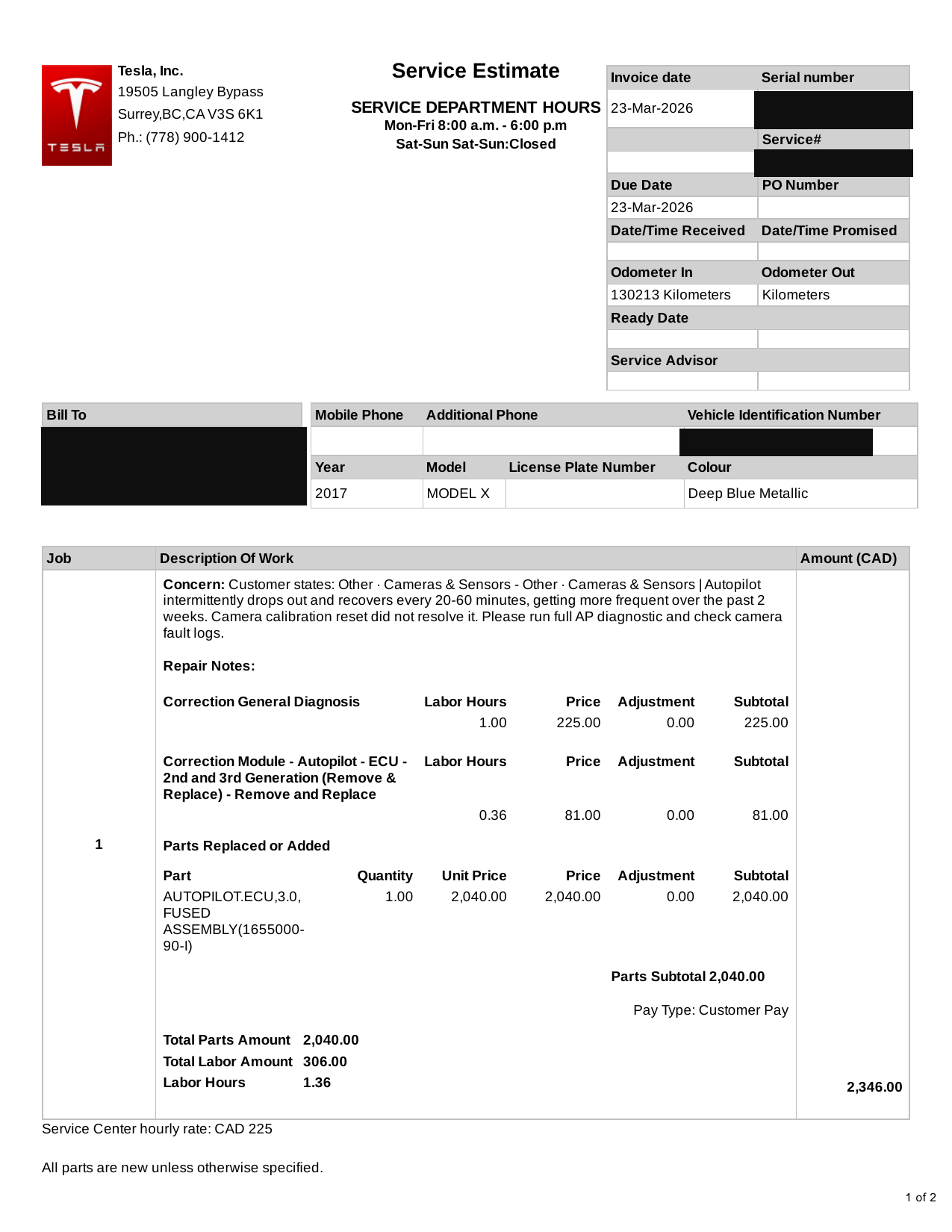
A camera started acting up, so I booked a service check. The first Service Center’s answer: replace the entire self-driving computer. The problem — I’d had that exact computer replaced less than a year earlier. So I declined, took it to a second Tesla store, told them the computer was already new, and asked them to actually find the fault. They dropped the visit to a $260 diagnostic and looked at the real problem.
The formal quote for the first proposed fix was $2,346 CAD — parts $2,040, plus labour. That’s a genuine invoice, on a car reading 130,213 km, dated to the month. The point isn’t that Tesla is dishonest; it’s that the first quote is not always the necessary one. Second opinion on anything expensive. An independent EV shop or a second Tesla store has saved me more than any single repair.
The warranty save (and how close it was)
The most expensive component on the car is the HV battery pack — $13,000–17,000 at Tesla, $9,000–12,000 refurbished, out of warranty.
Mine failed. It failed about two months before my battery warranty ran out, and Tesla replaced it at no cost under the 8-year coverage. The replacement is a refurbished pack that read 96% of capacity after its first handful of cycles.
Sit with the timing for a second. Two months on the other side of that date and this article would have a five-figure line item in it. That is the entire argument for knowing your warranty status to the month — not the model year, the actual build date and the actual remaining coverage. On a 2016–early-2020 build, battery and drive unit are covered 8 years with unlimited miles. It is the single most valuable, least-advertised fact about these cars. (I wrote the full buyer’s version of this in the used Model S/X checklist.)
So what does it actually cost per year?
Honestly? It depends on the car more than the model. But here’s the framing that’s served me:
- A used, out-of-warranty 2017 Model X is not a cheap car to run. Budget a real repair fund — a few thousand dollars a year — and you won’t be caught out. Treat “tires only” as the lucky outcome, not the expected one.
- The big risks are knowable before you buy: air-suspension age, drive-unit history, MCU version, half-shaft service-bulletin status, and — above all — exactly how much battery/drive-unit warranty is left.
- Most of the expensive failures give warning if you’re watching the right signals. My air struts didn’t announce themselves as a dropped corner until weeks after they’d started leaking — but the compressor was already working harder every night to keep up.
That last point is why I stopped guessing and started logging. When you can see the compressor duty cycle climbing, or the 12V resting voltage trending down, or the battery’s cell spread widening, the expensive surprises become scheduled maintenance instead. That’s the whole idea behind what I built — and the pre-purchase inspection is the same data, read once, before you inherit someone else’s deferred maintenance.
The invoices above are real. So is the fact that almost every one of them was visible in the data before it became a bill.
The full story of how a collision cascaded into $42,914 of repairs — and why I built a monitor because of it — is in the launch post. Costs in this article are in Canadian dollars unless noted; community ranges are USD as reported by owners, 2021–2026.