FSD v12.6.4 on HW3 vs FSD v14.2.2.5 on HW4, tested on real Vancouver roads.
I didn’t plan this comparison. The service appointment did.
My 2017 Model X 100D (HW3, with a paid MCU2 + HW3 retrofit done years ago) went into Tesla’s Vancouver service center for an intermittent Autopilot dropout — diagnosis: overheating in the self-driving control unit. Tesla replaced the Autopilot ECU (2nd and 3rd gen modules) under warranty. The loaner they handed me was a 2026 Model Y on HW4, and I had it for one day.
That one day is the entire HW4 data point in this article. I’m flagging that up front.
The numbers, straight from the cars
| Model X (mine) | Model Y (loaner) | |
|---|---|---|
| Year / Trim | 2017 100D | 2026 |
| AI Computer | Full Self-Driving Computer 3 (HW3) | HW4 |
| Vehicle software | 2026.14.6 (2026.14.3 at service handoff) | 2026.2.9.3 |
| FSD (Supervised) software | v12.6.4 | v14.2.2.5 |
| Mileage at test | 132,685 km | 8,598.9 km |
| Loaner cumulative FSD | n/a | 3,896.9 km · 45% of total · 0 strikeouts since v14.2 |
Both version numbers come straight off the Tesla app vehicle card and the in-car Software page. No interpretation, no overlay.
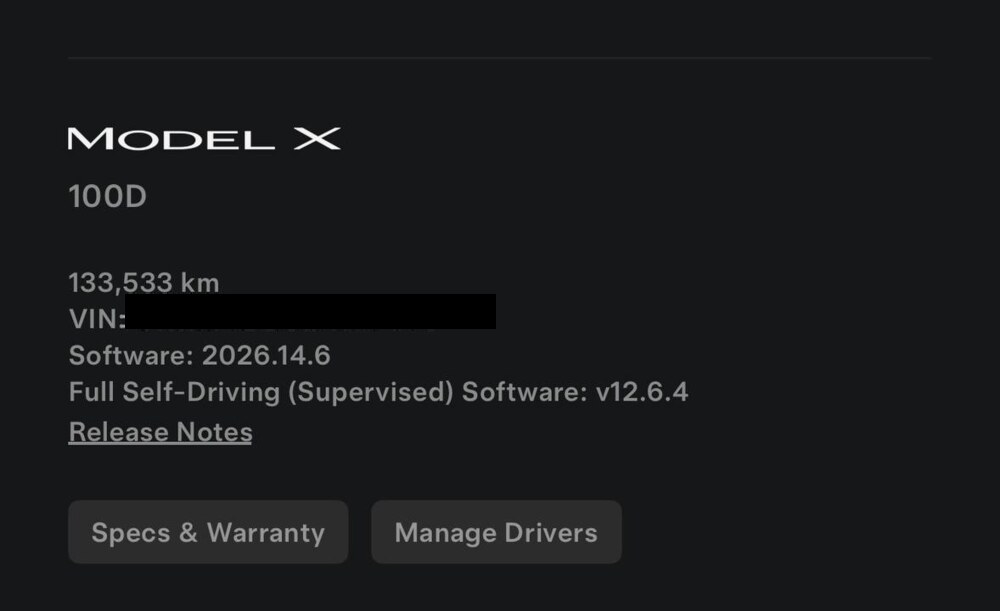 The Model X’s own software page: vehicle software 2026.14.6, FSD (Supervised) v12.6.4. VIN redacted.
A note on the footage
Two kinds of evidence, two different rules:
- Model X clips are my phone filming the Tesla in-car dashcam replay. You’ll see Tesla’s own overlay on screen: the exact date, time-of-day, location (“Surrey”), current speed, and the blue Self-Driving label live in the corner. None of that overlay is mine. What you see at
Wed, May 6, 2026 17:13:14is what the car was doing atWed, May 6, 2026 17:13:14. - Model Y clips are first-person POV from my Meta Ray-Ban glasses. You can see the windshield AND the center display at the same time. You can hear the turn-signal clicks, road noise, and me thinking out loud in broken English.
I kept the key overlays visible so the clips can be judged in context.
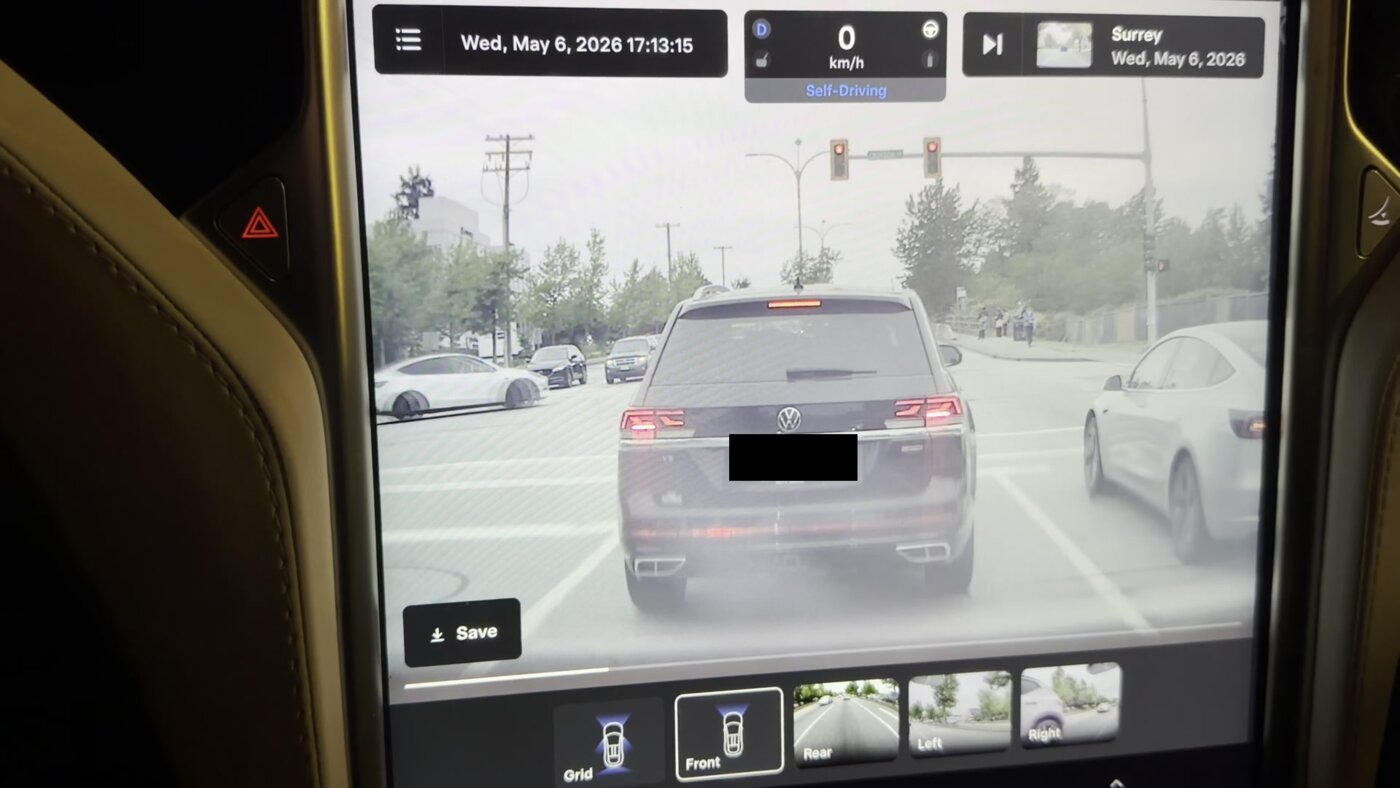 Model X: my phone filming the in-car dashcam replay. Tesla’s own overlay — date, time, speed, “Self-Driving,” location — is part of the frame. (A nearby plate is redacted.)
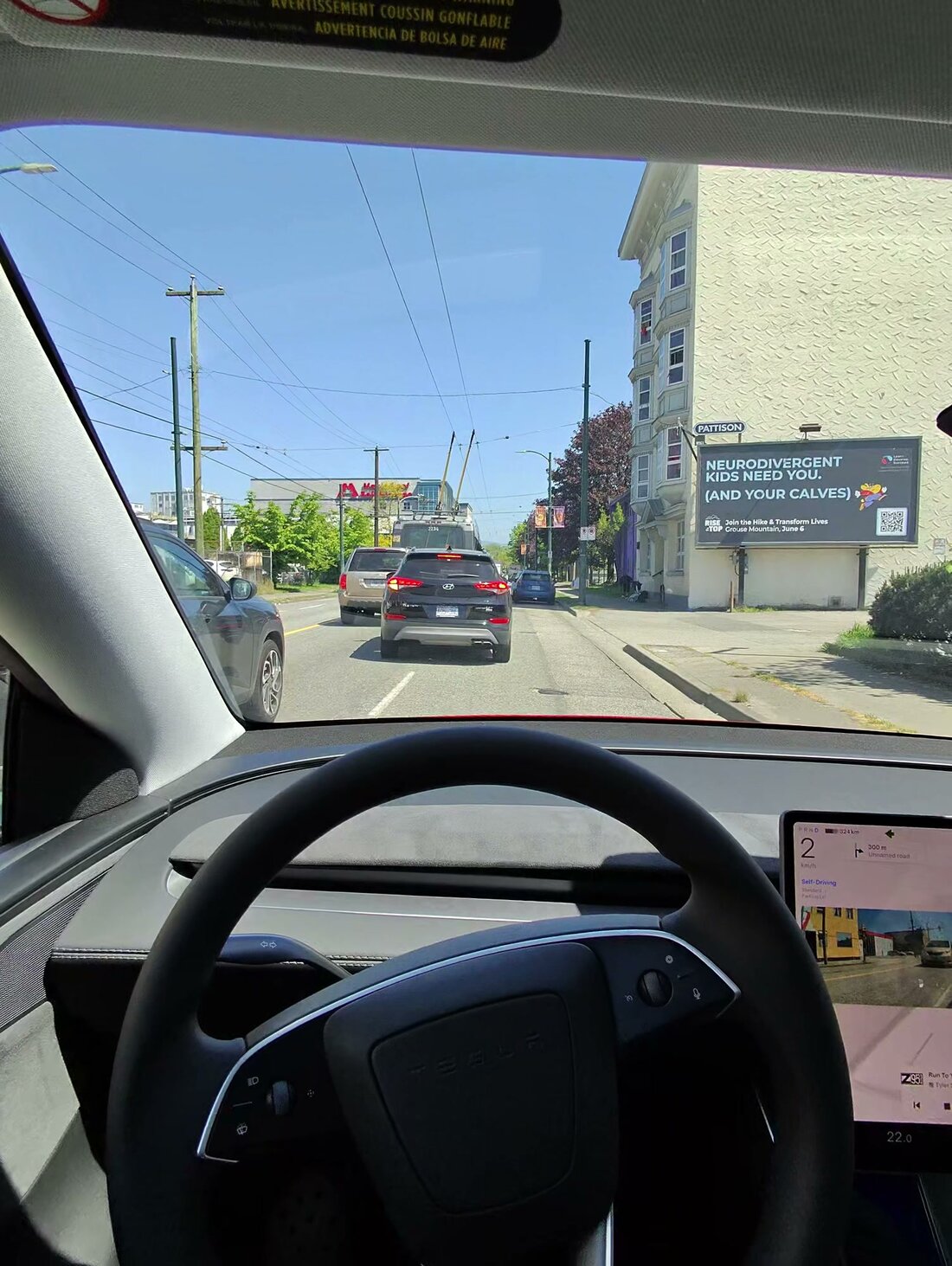 Model Y: first-person POV through Meta Ray-Ban glasses. You see the road and the center display at once.
What you’re actually comparing
People keep framing this as “HW3 vs HW4 on FSD v14.” That framing is wrong. HW3 does not run v14. The honest comparison is:
- HW3 → FSD v12.6.4 (the late v12 line, where HW3 effectively lives for my car at the time of testing)
- HW4 → FSD v14.2.2.5 (the newer v14 branch on HW4)
These are not the same software with different compute. They’re different generations of FSD. If you’re an HW3 owner deciding whether to keep paying for FSD month-to-month, the relevant question isn’t “is HW3 worse than HW4 on v14” — it’s “is v12.6.4 good enough for my drives.”
The HW4 loaner drive: White Rock → Vancouver, 47 km
The Model Y had to go back to the same Vancouver service center the next day — that’s where I was picking up the repaired Model X. So I ran the loaner from home in White Rock to 1772 Powell St:
47.1 km · ~43 min (Google estimate) BC-99 N → BC-91 N → Exit 22 Knight St → Clark Dr → Powell St
Roundabout exit, two highway merges, an exit ramp, dense city streets, parallel parking on Powell.
Zero interventions, door to door — including the final parking maneuver on Powell.
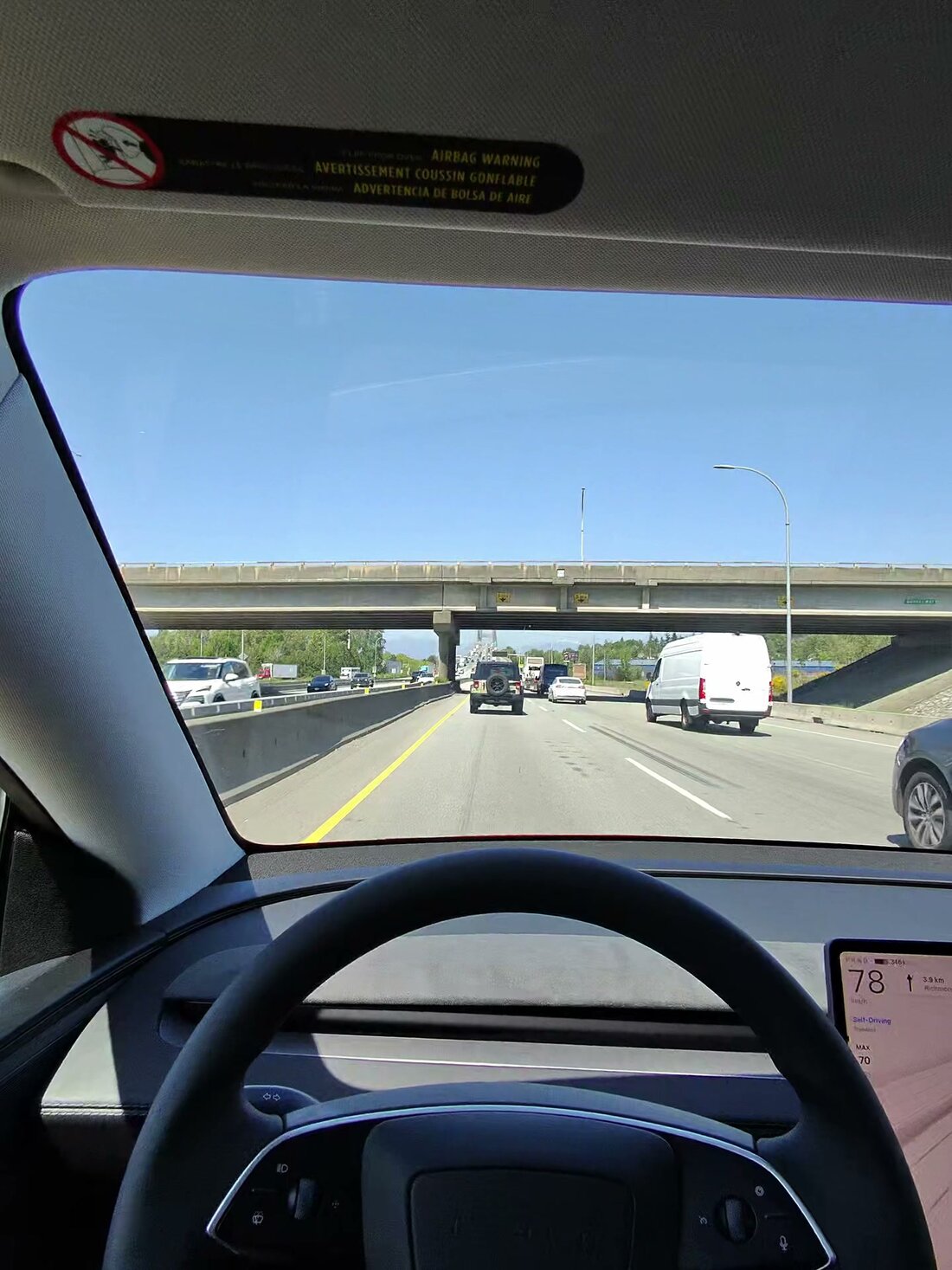 BC-91 in traffic, FSD engaged at 78 km/h. Merges and lane changes here were committed, not hesitant.
What that meant in practice:
- Lane changes in heavy BC-91 traffic were committed, not hesitant. The car picked gaps and took them.
- The Knight St → Clark Dr transition — a known-awkward two-lane exit ramp that funnels into city streets — was clean.
- Final parallel park on Powell worked the first try, including the back-and-forth correction to center in the box.
One drive is one drive. But the loaner’s own in-car stats screen adds another data point:
3,896.9 self-driving km out of 8,598.9 total km — 45% self-driving since v14.2 · 0 strikeouts
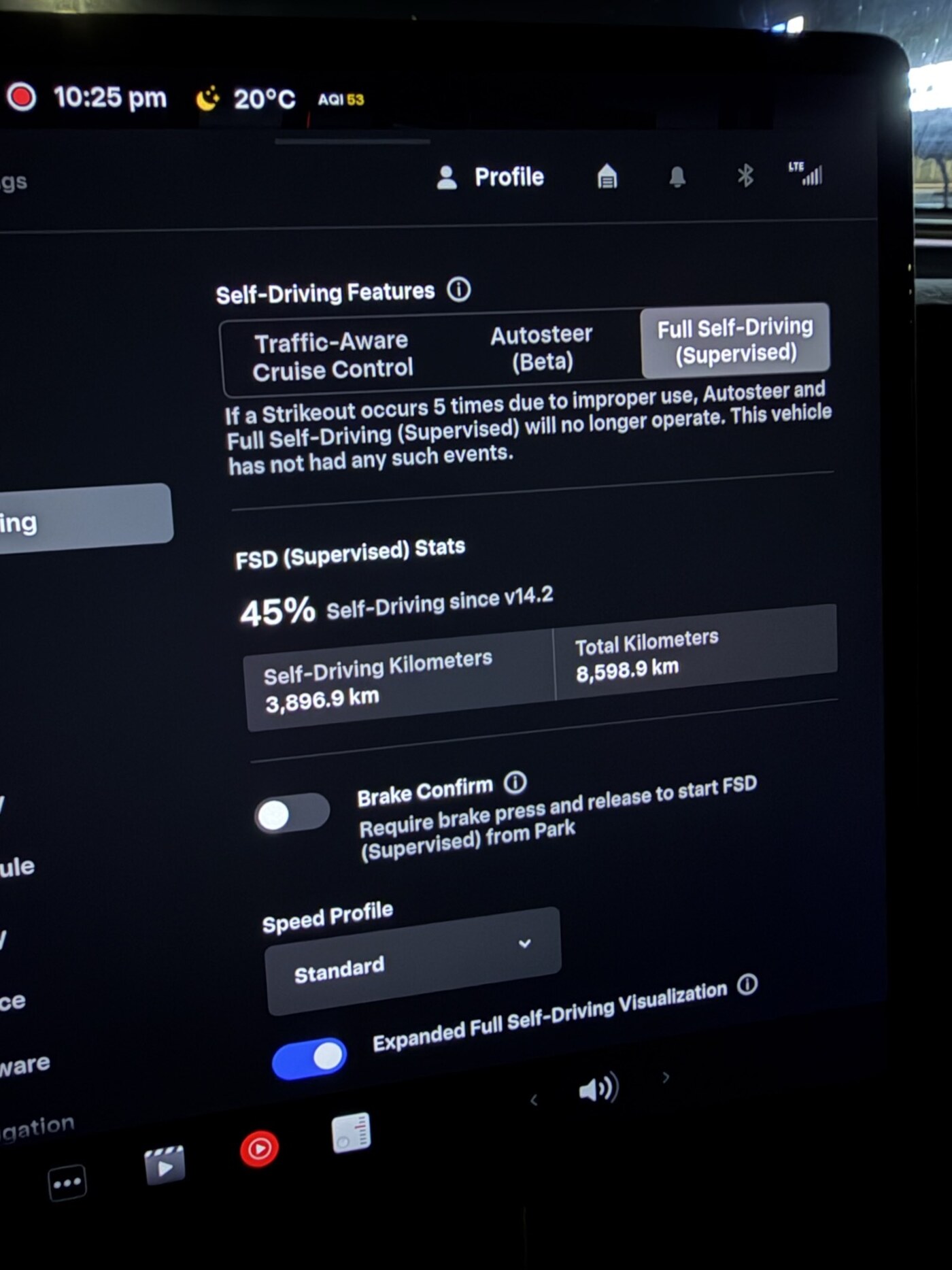 The loaner’s FSD (Supervised) stats screen, straight off the center display.
That number isn’t mine. It’s the cumulative behavior of whoever has driven this particular loaner since v14.2 rolled. It doesn’t prove how every HW4 car behaves, but it does show this particular loaner had already seen substantial supervised FSD use without a strikeout showing on that screen.
What v12.6.4 on HW3 still does well
This is the part most “HW3 is dead” takes get wrong.
- Stop signs — confident, clean stop and proceed, no rolling
- Predicted lane changes — the maneuver is flagged before it executes, feels deliberate, not jerky
- Right turns at signalized intersections — smooth, including right-on-red where legal
- Speed control on familiar street routes — reasonable, not jumpy
If your daily drive is suburban streets and you treat FSD as a more capable cruise + lane keeping, v12.6.4 on HW3 still does the job most of the time.
Where v12.6.4 on HW3 visibly breaks down
Three failure modes, all on camera, with Tesla’s own timestamp running:
1. Yellow-light hesitation
At a stale yellow, the car oscillated between “go” and “stop,” then crossed the stop line in a half-committed brake. A human would have either committed to going or stopped before the line. The car did neither.
2. Auto-park stuck
The maneuver started, the wheel cycled, the car sat in the middle of the stall and didn’t complete. I had to take over manually. (Tesla calls this “Autopark” under FSD; on HW3 / v12.6.4 it’s still where the system most visibly trips.)
3. Wrong-way / loop-near-destination
Approaching the destination, the car circled the block trying to re-acquire the right approach. Eventually I drove it in.
None of these are subtle. They’re the kind of thing a passenger notices.
Where v14.2.2.5 on HW4 pulled ahead
“Composure” is the word that keeps coming back. On the White Rock → Vancouver run, v14 didn’t second-guess itself the way v12.6.4 does on the Model X.
The interesting part: HW3 was fine on single moves (a stop sign, a right turn, an isolated lane change). It’s the transitions — stale yellow lights, multi-step parking, recovering from a missed turn — where the older stack hesitates.
v14 on HW4 didn’t produce those half-commit moments on this run.
Where both still fail (same bug class, both generations)
End-of-route localization.
- HW3 / v12.6.4 has looped near my home, unable to commit to the final approach.
- HW4 / v14.2.2.5 has, at night, parked at a neighbor’s house and then tried to cut through another neighbor’s driveway to recover.
This isn’t a hardware story. It’s a map/localization story, and it shows up regardless of generation. Online clips of end-of-route mistakes get attention for a reason: this class of failure is easy for humans to notice and hard to forgive.
The unglamorous problem nobody demos: knowing which driveway is yours.
The HW3 hardware footnote
The car is nine years old, and even with the HW3 retrofit, the FSD computer is still an older hardware generation now being asked to run the mature v12 line. The thermal issue I had serviced is part of that ownership context. The Tesla service notes on mine read:
“The concern was traced to the self-driving control unit operating outside its normal temperature range. We replaced the autopilot control unit and updated the necessary firmware to address this.”
Replacement was under warranty in my case. The cabin display was still showing “Calibration In Progress” on the rear-view tile when I took the car back. That’s the camera calibration validation running after the ECU swap.
I mention this for one reason: when you’re judging HW3 on v12.6.4, you’re judging an older silicon generation running a mature v12 branch while HW4 cars are already on v14. That’s not v12.6.4’s fault, but it’s part of the picture if you own an HW3 car.
So — should an HW3 owner keep paying for FSD?
I’m not telling you yes or no. Here’s the framework I’d use:
Probably yes, if:
- Your drives are mostly suburban streets
- You treat FSD as supervised cruise + lane keeping
- You don’t depend on Autopark for tight spots
- You’re already comfortable disengaging when the car hesitates
Probably no, if:
- You do long highway runs where v14’s composure would actually matter
- You need reliable urban parallel parking
- You’ve had multiple “I had to take over” moments per drive
- You’re paying month to month and the experience isn’t sticking
A month-to-month subscription lets you test and bail. A multi-thousand-dollar buyout on a nine-year-old car with older-generation hardware is a different math problem.
Should you replace the car?
The FSD delta alone doesn’t justify it.
But if you were already replacing the car for other reasons — range, comfort, the rest of the 2026 interior — the v14 + HW4 experience is meaningfully different. Not “marginally better.” Different.
The single thing I’d ask Tesla to fix on both
Destination localization. Neither v12.6.4 nor v14.2.2.5 reliably knows which driveway is mine. That’s the problem hiding under all the highway-merge demos, and it’s the one that turns “self-driving” into “almost self-driving with an annoying last 50 meters.”
Harrison runs t800.io, a Tesla health monitoring project built around his own 2017 Model X 100D. The Model Y in this article was a Tesla service loaner. No commercial relationship with Tesla.