This is a launch post. If you’ve followed the Tesla Longevity Lab channel or seen me reply to threads on Tesla Motors Club and Reddit, you know what I’ve been working on. Today I’m taking the wraps off.
Today, two things go live:
- t800.io — the website for T800, a long-term health monitoring system for Tesla Model S/X.
- t800.io/garage — a public daily health report for my own 2017 Model X 100D, updated every morning. Real CAN telemetry, not a mockup.
That’s the launch. Below is the why.
Why I built this
In early February 2025, my 2017 Model X slid on snow and hit a bridge pier. The car drove normally — I drove it to the body shop myself. Two and a half months later, ICBC paid $25,905 to fix the body, the subframe, the frame rail, the headlights, the A/C condenser, the suspension compressor — damage that was invisible from the outside.
The body shop did everything they could see. But over the next few months, more failures kept showing up:
- Both front air struts were leaking. Tesla diagnosed it the way they still diagnose air suspension in 2026: park the car on “very high” mode, tape masking tape on all four corners, come back the next morning, see how far it sagged. → $5,612 CAD repair (why the same symptom bills anywhere from $425 to $5,612: Tesla air suspension repair costs)
- The HV battery pack failed while the car was sitting at the body shop during an ICBC dispute. I had it flat-bedded to Tesla. → Replaced under warranty (free, but a $5,612 tow-and-repair visit). The replacement pack is the one now tracked in the garage — how much cell imbalance is normal and what a pack replacement actually costs.
- The steering intermediate shaft + sway bar end links (missed during the original collision repair). → $1,044 combined
- The cabin PTC heater shorted out. → $1,853
- Both headlights had internal faults. → $7,536
Combined with the body shop bill, my last 12 months on this car cost $42,914 CAD. The full story is on the About page.
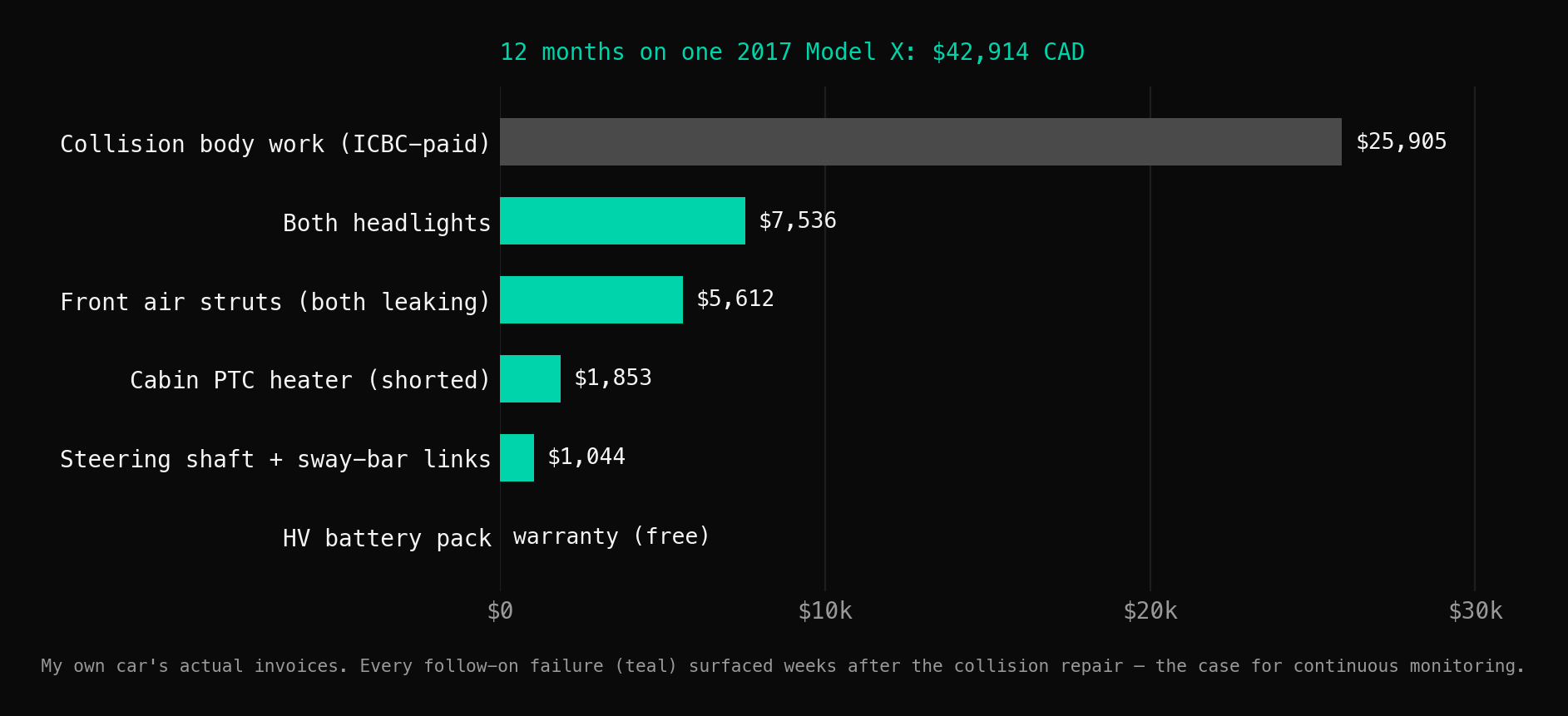
Some of that was unavoidable. A frame-bench job is a frame-bench job. But every single one of those follow-up failures was something a continuous monitoring system could have either flagged earlier or caught before the warranty ran out — the 12V decline and phantom drain that the app never shows, and the degradation trend you can only see by measuring daily. Tesla’s overnight tape test is a clever workaround, but it’s a workaround. By the time you can see the corner sag, the spring has been losing pressure for weeks.
I’m an engineer. I have the time and the inclination to fix that for myself. So I built the thing I wanted: a passive CAN-bus listener that runs in my garage, processes the telemetry locally, and produces a daily health report covering 6 vehicle subsystems. After a few months of running it on my own car, I started writing it up properly. That’s T800.
What you can see today
t800.io/garage
This is the page I’m proudest of. It’s my own car’s daily health report, generated this morning, updated every day at 4:35 AM Pacific.
Right now the garage page is useful for something more specific: seeing the real system, on a real car, with its uncertainty left intact. Suspension in particular is under active validation — the public report shows the telemetry, but I am not pretending every internal signal is ready to become a customer-facing leak alert.
You can see:
- 4 monitored subsystems visible in the report: Air Suspension, 12V System, HV Battery Pack, Charging System
- 2 still calibrating: Thermal Management, Drivetrain Efficiency (these need more data to set baselines, so they don’t affect the overall status yet)
- For each monitor: the metrics, the 30-day baseline, the threshold, the rating, and a plain-English interpretation
- The previous day’s activity (driving distance, charging energy)
No mockups. No “your data may vary”. This is my actual car.
The website itself
t800.io explains the product, the pricing model ($49/month + $300 refundable hardware deposit), the technical approach (passive CAN bus reading via OBDLink MX+, no commands sent to the vehicle), and includes:
- About — the founder story with the actual 12-month service history
- Features — what each of the 6 monitors detects
- How It Works — hardware setup, the three networks (BLE, Wi-Fi, OBD)
- Pricing — straight pricing, no asterisks
- Privacy — what we collect, what we don’t, what we’ll never sell
Where this is going
Now — public website, public daily report, waitlist open.
Next 4-8 weeks — finishing the iOS app, building the cloud read API for daily digests, ordering the first batch of T800 Boxes, and shipping to the first waitlist members.
After that — expanding early access, starting in Canada (where I am, where the logistics are simple), then the US.
If you’ve ever been frustrated by a Tesla service visit where the answer was “we’d need to keep it overnight to find out”, or paid for a repair you suspected was avoidable — join the waitlist and I’ll keep you posted.
If you have a Model S or Model X and you’ve been keeping detailed records of repairs and quirks — I’d love to hear from you. Email me at [email protected]. I’m building this mostly alone, and real data from real cars is what makes it better.
Useful links
- 🌐 t800.io
- 📊 My live garage
- 📝 The story
- 📩 Join the waitlist
- 🐦 T800 on X
- 🎥 YouTube channel (videos coming soon)
— Harrison