The most expensive lesson in my ownership-cost writeup was a single line: $5,612 for both front air struts. Both were leaking. And the part that stuck with me wasn’t the number — it was the timeline. By the time a corner visibly sagged in the driveway, the springs had been losing pressure for weeks. The failure was slow, invisible, and completely knowable in advance. I just wasn’t watching.
So after that bill I did the obvious engineer thing: I started logging the suspension pressure off the CAN bus. The first thing I learned surprised me — a healthy air spring leaks all day, every day. Detecting “a leak” is trivial and useless; the whole car is leaking right now. The real problem is telling a normal leak from a failing one.
My first attempt at that got it embarrassingly wrong. This is the honest version of how I fixed it.
Your air suspension leaks by design
An air spring is a rubber bladder holding compressed air. Air permeates slowly through rubber, so every corner loses a little pressure continuously. The suspension ECU watches for this and periodically tops each corner back up by firing the compressor. The result, if you log one corner’s pressure over a day, is a sawtooth:
0x210 — and pressure jumps back up. On my car this cycle repeats about every 2.5 hours. ‘Leaking’ isn’t the fault. It’s the normal state.A quick honesty note on units: the pressure signal (0x3F8) reads in raw sensor units, and I’ve never found a clean raw-to-psi conversion I trust for this car. So I don’t reason about absolute pressure — I reason about shape: how fast a corner falls, how the four corners compare to each other, and how often the compressor has to intervene. Shape is where leaks hide, and shape doesn’t need a unit conversion to be trustworthy.
That reframes the question. It’s not “is it leaking?” (always yes). It’s “is this corner leaking faster than it should, or faster than its siblings?”
What healthy looks like
Here’s a 17-day baseline from my car in February. The cleanest signal is how the four corners compare:
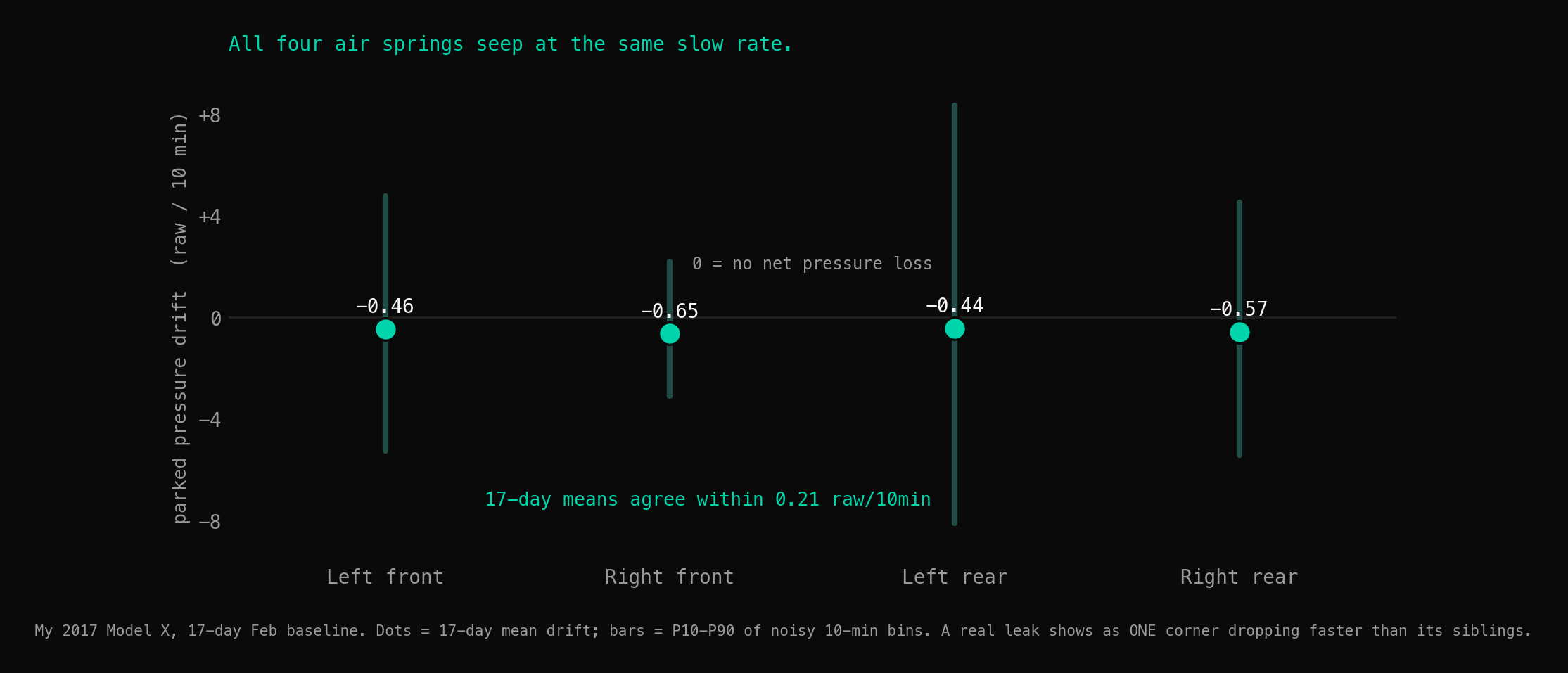
That’s the fingerprint of a healthy system: all four corners bleeding at the same slow rate, none pulling away. A few more things the baseline showed:
- Parked balance held steady. The four corners always settled in the same order (right-front highest, left-rear lowest), and the spread between them stayed under ~10 raw units against a 30-unit concern threshold. The left rear sits about 8 units low consistently — that’s weight distribution, not a leak, because it never drifts, it’s just always there.
- The compressor sips, it doesn’t chug. Across the baseline I counted 302 compressor events, median duration 23 seconds each. A healthy compressor does lots of short top-ups. Long runs are what you worry about — a compressor fighting a leak it can’t win.
- No trend over 17 days. Leak rate flat, balance flat, no corner degrading. Boring, in the good way.
If I’d stopped there, I’d have written a tidy post about my healthy suspension. Then April happened.
Then my own monitor cried wolf
I’d built five metrics to flag a developing leak. In April, they lit up: six days flagged as possible leaks in three weeks. For a moment I thought I’d caught one forming — the exact early warning I built the thing for.
Then I looked closer, and the story fell apart:
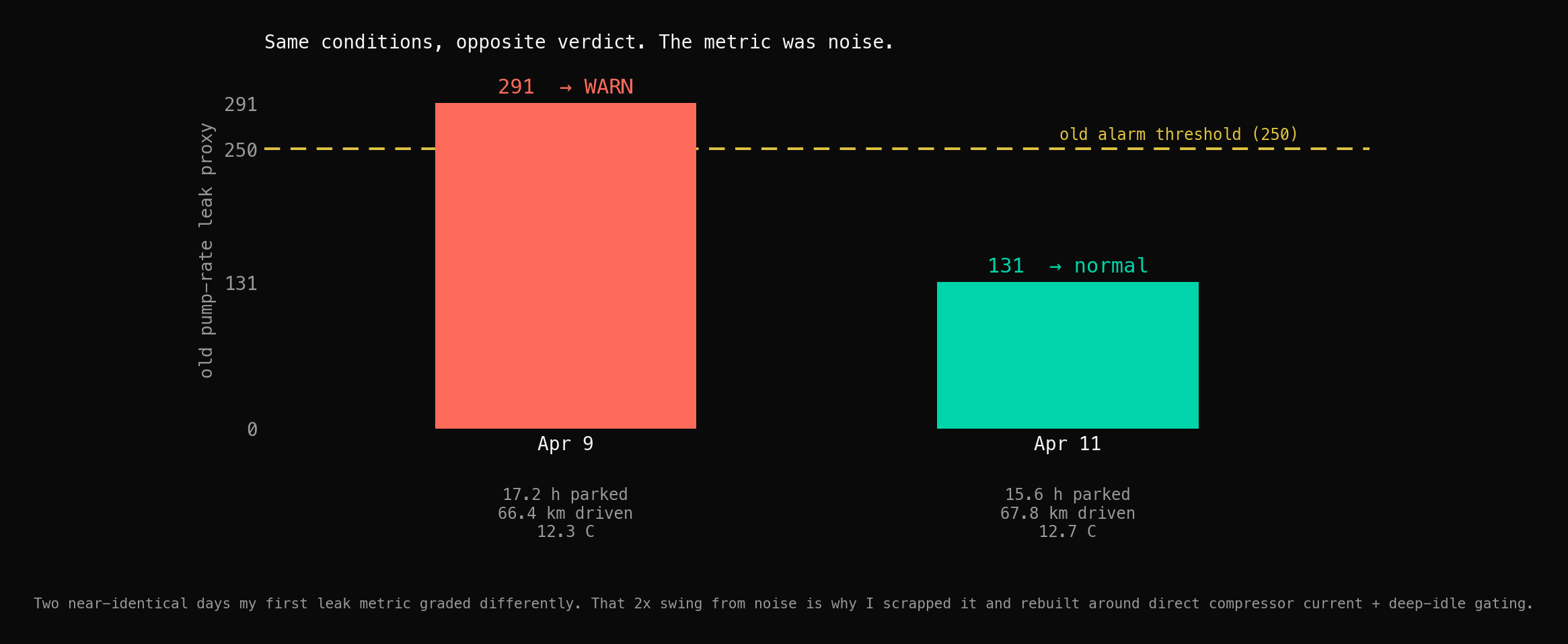
Two days, almost identical in every condition that should matter, graded a full 2× apart. A real leak doesn’t switch on for a Tuesday and off for a Thursday. The metric wasn’t detecting leaks. It was detecting noise, and dressing it up as a verdict.
Here’s why it fooled me, and it’s worth sitting with because it’s the whole lesson. All five of my metrics were built on one weak foundation: minute-by-minute pressure rises, which I’d treated as compressor activity. But a pressure blip can come from a dozen things — cabin preconditioning warming the air, a charging session’s thermal cycle, the outside temperature swinging the gas law around, someone just getting in the car. Five metrics all reading the same noisy foundation, and when they “agreed” and escalated to a warning, it felt like five independent confirmations. It was one error, counted five times.
(If that sounds familiar, it’s the same trap I wrote about with the battery’s isolation-resistance false alarm — a monitor talking itself into a conclusion. Different signal, identical failure mode.)
The rebuild: measure the compressor, not the guess
The fix was to stop inferring the compressor from pressure noise and measure it directly. The compressor draws real current when it runs — a pulse above 25 A on 0x210 — and that’s a signal that isn’t fooled by cabin heating or a gas-law wobble. So I rebuilt the detector around three rules:
- Trust the current, not the pressure guess. A compressor event is a real current pulse, full stop.
- Only count it during deep idle — car not driving, not charging, not running climate, not changing ride height. Everything that used to contaminate the signal is now explicitly excluded.
- Compare against this car’s own baseline, not a universal threshold. “Normal” is defined per-car.
The clincher came from re-running 59 days through the rebuilt detector: 58 of 59 days showed essentially zero real suspension-compressor activity — which is exactly what a sealed, healthy air suspension should read. And the scariest-looking day in the whole window — one that showed 73 minutes of apparent “compressor” runtime — turned out, on inspection, to be cabin heating during preconditioning. Not the suspension at all. My old metric would have escalated it to a full alarm.
I’ll be straight about where this leaves the product: suspension is the most conservative monitor I run, and it’s deliberately still in a long soak before it’s allowed to raise anything customer-facing. I’ve been fooled once. I’m not wiring up an alarm I don’t yet trust. What it does today is quieter and more honest: it knows this car’s normal, and it stays silent unless something sustained and real breaks out of that baseline.
Why this is the whole game
The naive way to watch an air suspension is to ask “did the car sag overnight?” That check fails twice over. It misses slow leaks — a spring can bleed faster than normal for weeks while the compressor quietly keeps the corner topped up, so the car looks perfectly level right up until the day it doesn’t. That’s precisely how my $5,612 surprise happened. And it cries wolf on every cold night, when the gas law drops pressure across all four corners and nothing is actually wrong.
The value isn’t catching the sag you can already see in the driveway. It’s seeing the degradation while the car still looks and drives completely normal — and doing it without a false alarm every time the weather turns. That’s a harder problem than it looks, which is exactly why my first version failed it, and why the rebuilt one earns its verdict slowly.
A healthy air suspension leaks all day long. The skill is knowing, precisely, what your car’s healthy leak looks like — so you can see the day it stops being healthy, weeks before it becomes a $5,612 line item.
This runs on my actual car. How the monitor works covers the full signal stack, and the live garage shows the current readings. If you’re shopping for a used Model S or X, air-suspension age and history are near the top of what a pre-purchase inspection checks — because inheriting someone else’s slow leak is one of the more expensive ways to start Tesla ownership. The full cost story is in what a used Model X actually costs to own.