Here’s a question that comes up constantly in Tesla owner forums, almost word for word:
“Coming up on 200k km. Tesla’s battery health test says 78%, but the OBD data works out to about 73%. Where does the difference come from — and which one is right?”
It’s a good question, and the answer matters, because a five-point gap sounds like the difference between a healthy pack and one heading for trouble. So people panic. They shouldn’t — and the reason why is a nice illustration of the difference between a number and a measurement.
The two numbers aren’t measuring the same thing
Tesla’s Battery Health Test is the official estimate from the Battery Management System (BMS). It runs a controlled calibration routine and reports the pack’s usable energy under Tesla’s own methodology. This is the figure Tesla uses internally for warranty decisions, and it’s deliberately conservative and repeatable.
An OBD “nominal full pack” reading (what you get from an app like ScanMyTesla over an adapter) is a different animal. It’s the BMS’s running estimate of full-pack energy at the exact instant you read it. It’s genuinely useful — it’s the same access Tesla’s own tools use — but it has two properties people forget:
- It includes the buffer, and so does the “when new” value you compare it against. You never add the buffer back in; every capacity figure the car reports already has it baked in. Getting that wrong is where a lot of the confusion starts.
- It drifts with your recent charging. If the pack hasn’t seen a proper low-to-high range in a while — lots of shallow mid-SOC top-ups, which is how most of us actually charge — the running estimate can sit a percent or two low until the BMS gets a chance to recalibrate.
So when you put “78% from a controlled calibration” next to “73% from a running estimate that happened to be read on a shallow-cycle week,” you’re not catching Tesla in a lie. You’re comparing two point-in-time estimates of a slowly-moving quantity, taken by two different methods.
What real degradation actually looks like
This is where continuous data settles the argument. Here is my own 2017 Model X 100D — pack cell capacity (CAC) read off the OBD port and logged every day for seven months:
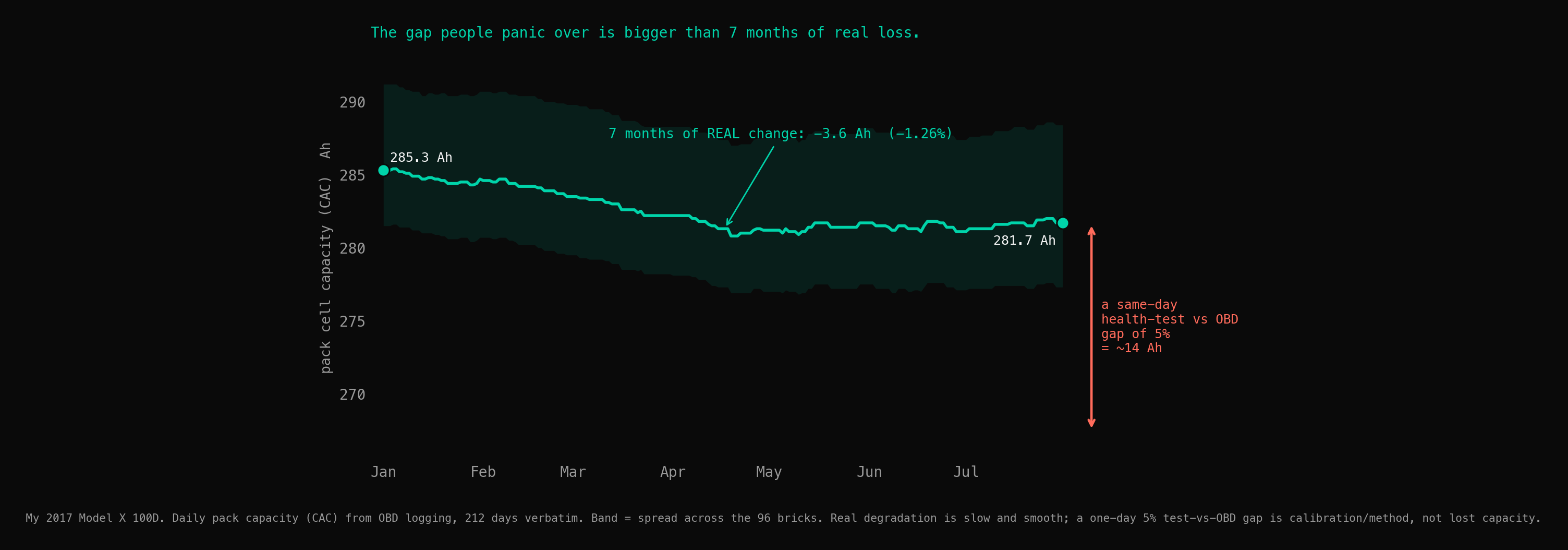
The line goes from 285.3 Ah to 281.7 Ah over 212 days. That’s −1.26% in seven months, and the day-to-day movement is almost nothing — a few tenths of an amp-hour at most. Real degradation, when you actually watch it, is slow and boring. That’s what healthy looks like.
Now look at the red bracket on the right. A 5% same-day gap — the “78 vs 73” that started this — works out to about 14 Ah on this pack. That is roughly four times my entire seven months of real change. A pack does not quietly lose four months’ worth of capacity between two readings taken on the same afternoon. The gap isn’t degradation. It’s calibration and method, exactly as you’d expect from two different estimates.
So how do you know your pack’s health?
You watch the slope, not the snapshot.
Any single number — health test or OBD — is one sample of an estimate. The health test is a good sample because it forces a calibration; an OBD reading is a good sample if you know it’s a running estimate and treat it accordingly. Neither is “the truth” on its own. The truth is the trend line: where has capacity actually gone over months, and how fast.
If you specifically want the two numbers to reconcile, give the BMS what it needs: a near-full charge followed by a deeper-than-usual discharge, then re-read over the next cycle or two. The OBD estimate usually tightens back up toward the calibrated figure once the BMS recalibrates. But that’s a party trick. The thing that answers “is my battery okay?” is the shape of the curve above, not two snapshots agreeing.
The honest limits
A few things I’m not claiming:
- I’m not saying OBD is wrong, or that the health test is wrong. They’re both fine at what they do. The mistake is treating either single number as gospel.
- I’m not claiming my logging is more accurate than Tesla’s BMS. It reads the same BMS. The only thing continuous logging adds is time — the one dimension a single test can’t give you.
- The rounded “capacity %” a lot of tools show (mine reports a flat spec-derived number) is not the signal to watch. The per-cell capacity trend is. Track the thing that actually moves.
Bottom line
A few-percent gap between Tesla’s battery health test and your OBD scan is normal, expected, and almost never real lost capacity. Both are point-in-time estimates; one is calibrated, one drifts. Stop comparing two numbers from the same day and start watching one number over many days. That trend is the only battery-health figure that has ever told anyone the truth.
That’s exactly what we do continuously — see the live garage for a pack being tracked this way in the open, how the monitoring works, or what a data-based pre-purchase inspection reads off a car you’re thinking of buying.