Here is the uncomfortable truth about any health monitor: it is only worth the one alert you actually believe.
The first time your car monitor cries wolf, you forgive it. The second time, you start to doubt it. By the third, you’ve muted the notifications — and now the expensive failure it was built to catch sails through to a dead car in a parking garage. A monitor you’ve learned to ignore isn’t a safety feature. It’s a widget.
So the hardest engineering in this whole product isn’t detecting problems. The car practically hands you the anomalies. The hard part is restraint — being ruthless about your own false positives so that the day your phone finally buzzes, you move. Last week my own monitor put that discipline to the test, on my own car, and it’s worth showing you exactly what happened.
The tiers: most days should be silent
My monitor doesn’t have an on/off alarm. It has four levels, and the whole design is about keeping days in the low ones:
The observe tier is the important one to understand. It’s not an alarm. It’s the system saying, quietly and to itself, “that reading is slightly outside baseline — worth a look.” It exists so a human (me, today) can catch edge cases before they’d ever escalate to your phone. When it works, you never even know it fired.
Last week it fired twice.
60 clean days, then two flags
My Model X had run 60 days without a single flag. Then, last week, two observe flags landed two days apart — one on the high-voltage battery, one on the 12V. Both looked, at a glance, like something you’d want to know about. Neither was real. Here’s each, with the actual data.
Flag 1: an “8.5°C battery temperature spread”
The HV-battery monitor flagged a module temperature spread of 8.5°C, over its 8°C threshold. On a battery pack, a temperature imbalance is a real thing to watch — so the flag isn’t crazy on its face. But look at where the number came from:
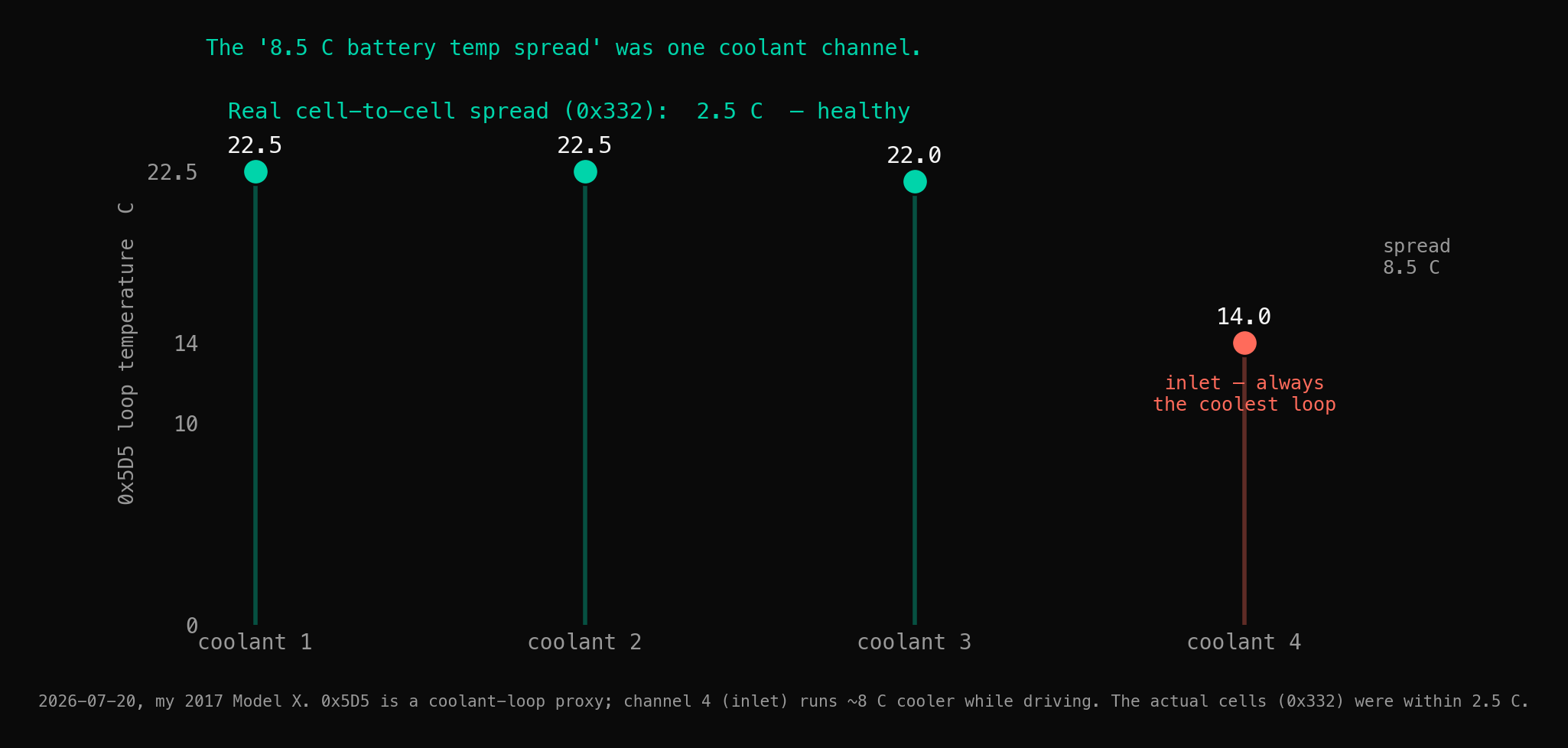
0x5D5) is a coolant proxy, not the cells. The real cell-to-cell temperature, from the validated 0x332 signal, was 2.5°C — perfectly healthy.Three of the four coolant channels sat around 22°C; the fourth — the inlet — sat at 14°C, because coolant is coldest where it enters the loop. That’s plumbing, not a battery fault. The metric was reading a coolant gradient and calling it a cell imbalance. Meanwhile the signal that actually measures cell-to-cell temperature read 2.5°C, well inside healthy. (This is the same “measure the right signal” lesson as the air-suspension story, where a pressure proxy fooled an earlier version of that monitor.)
Flag 2: a “12.15V low 12V battery”
The next day, the 12V monitor flagged a resting voltage of 12.15V, just under its 12.2V watch threshold. A low 12V resting voltage is one of the best early warnings of a dying 12V battery — so, again, not a crazy thing to flag. But look at the minute it came from:
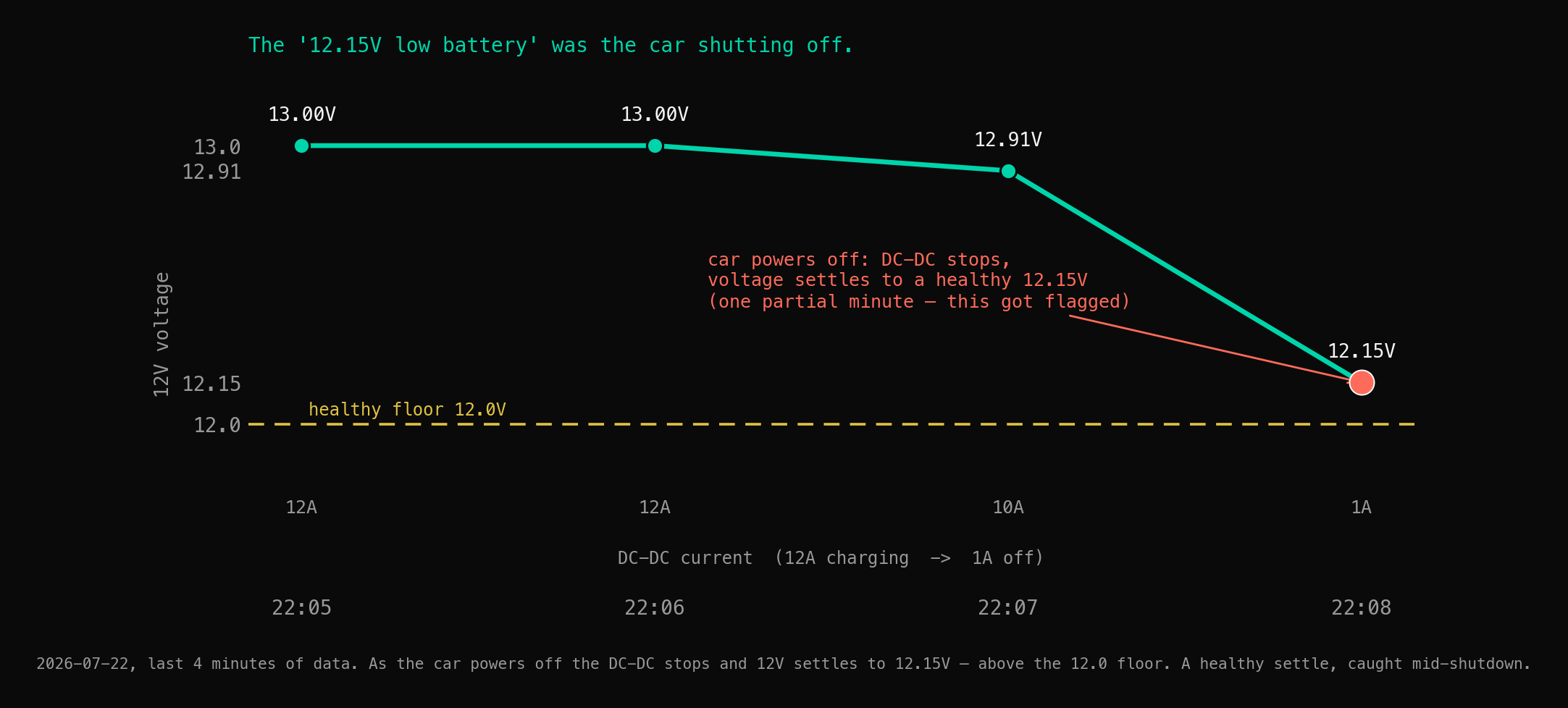
The car was awake and the DC-DC converter was holding the system at 13.0V. Then it shut down for the night, the converter stopped, and the voltage relaxed to its resting value of 12.15V — a healthy number. The monitor caught that single transitional minute, treated it as a resting-voltage sample, and flagged it against a threshold meant for genuine overnight sleep.
The same trap, twice
Strip away the specifics and both flags are the identical mistake: alarming on a fragment or a proxy instead of a sustained, correctly-measured condition.
- The temperature flag trusted a proxy (coolant loop) instead of the real signal (cell cores).
- The 12V flag trusted a fragment (one power-off minute) instead of a real, sustained sleep.
This is the oldest trap in monitoring, and it’s exactly how systems train their owners to stop listening. It’s the same failure mode behind the single-frame isolation reading I wrote about earlier — one spurious sample out of 789,272 that a naive monitor would have screamed about. The cure is always the same shape: don’t react to a moment; react to a condition that holds.
The fix is the product
So we fixed the definitions, the same day:
- The coolant proxy is now context-only. It’s still logged and shown, but it can’t raise a flag. The temperature alarm now listens only to the validated cell-core signal — which read 2.5°C, healthy.
- Resting voltage now requires a real, sustained sleep — a confirmed sleep-to-wake cycle with enough quiet minutes — before it’s allowed to alarm. A single power-off minute can’t trip it anymore.
Then the part that actually matters: we re-ran the history. Both days came back normal. All 32 of 32 regression tests still pass, so the tighter definitions didn’t blind the monitor to anything real — a genuine cell imbalance still trips the cell-temperature alarm, and a genuinely dying 12V still trips a low resting voltage during real sleep. The change removed the artifacts and nothing else.
Notice what never happened in this whole story: your phone never buzzed. Both flags lived and died in the silent observe tier, exactly where they were supposed to. A human reviewed them, found them empty, and tightened the net. That’s not the monitor failing — that’s the shadow tier doing its entire job.
The discipline is the whole point
A monitoring system’s credibility is not measured by how many things it flags. It’s measured by whether you believe the one alert it finally sends you at 2 a.m.
Every false alarm you ship spends trust you can’t easily buy back. So we spend our engineering on the opposite problem — making very sure that when the notification finally comes, it means something. Sixty quiet days, two silent false flags, both caught and fixed before they could ever reach you. That restraint isn’t a limitation of the product. It is the product.
This monitor runs on my own 2017 Model X. The live garage shows its current readings, and how the monitor works walks through the full signal stack and the alert tiers end to end. The three deep dives behind this post: the isolation-resistance false alarm, the air-suspension “healthy leak”, and the 12V warning signs.