You’ve found the used Model X. The photos look right, the test drive was fine, the seller seems honest. So you do what you’d do with any used car — call to book a pre-purchase inspection.
And you hit a wall. Tesla won’t inspect a car you don’t own yet.
This is one of the most common and least-expected roadblocks in the used-Tesla process, and it catches almost everyone off guard. Here’s why it happens, and — more usefully — the three real options you actually have.
Why Tesla says no
Tesla Service is built around the owner’s account. To book any appointment, the car has to be attached to an account, and the appointment goes to the account holder. As a prospective buyer, you’re not on that account, so you can’t schedule anything. Buyers run into this constantly:
Multiple owners have documented trying to book a pre-purchase inspection through Tesla and being turned away because the car wasn’t on their account. (r/TeslaLounge, r/TeslaModelX)
Some sellers will book a service visit themselves and share the result, but that puts the diagnosis entirely in the seller’s hands — not ideal when you’re the one taking the risk. So the practical reality is: if you want an independent read on a used Tesla, you have to arrange it yourself.
Why a Tesla PPI is different from a normal-car PPI
On a gas car, a good mechanic on a lift can see most of what matters — compression, leaks, wear, rust, brakes. On a used Tesla, the repairs that can total the car don’t show up that way. They hide in the car’s data:
- How the battery was actually used. A car whose previous owner supercharged almost exclusively can have a prematurely aged pack — invisible on a test drive, obvious in the charge-history counters.
- Cell balance and true capacity. The dashboard range estimate is a proxy; the BMS knows the real numbers.
- High-voltage isolation. The safety signal behind leak, shock, and post-collision risk. Nothing on a test drive tells you this.
- Air-suspension leak behavior. By the time a corner visibly sags, the spring has been losing pressure for weeks.
A used-Tesla inspection is really a data inspection. That’s what shapes the three options below.
Your three options
Option 1 — A third-party EV-savvy shop
An independent shop that knows EVs (ideally Teslas specifically) can do a proper mechanical PPI: suspension and control arms, half-shaft play, brakes, tires and alignment wear, body and panel gaps, water leaks, door mechanisms. This is genuinely valuable — these are real failure points on the S/X, and a good technician will spot them.
- Strengths: hands-on mechanical assessment; catches suspension, body, leak, and tire issues; a human who’s seen a hundred of these.
- Limits: most general shops don’t read Tesla’s CAN/BMS data deeply. They’ll assess the car a skilled mechanic can see — not the battery’s lifetime charge history, cell balance, or isolation resistance. And EV-fluent shops aren’t everywhere.
- Cost: typically $100–250, like any used-car PPI.
Option 2 — DIY: an OBD adapter + ScanMyTesla
You can read the car’s own data yourself. A Bluetooth OBD-II adapter (an OBDLink MX+ is the reliable choice, ~$100; cheaper adapters exist) plus an app like ScanMyTesla streams live pack voltage, individual cell voltages, temperatures, and dozens of other signals.
This is a real superpower — it’s the same access Tesla’s own tools use — and for an enthusiast it’s the best $40–100 you can spend. But be honest with yourself about what it is:
- Strengths: direct access to the actual data; cheap; live.
- Limits: it’s a live gauge, not a report — and it shows you this instant, a snapshot, not a picture built from a window of readings. You have to know which signals matter and what “normal” looks like. Some published decode formulas are mux-blind and can be flat wrong on S/X — one static formula reads a healthy 3.88 V cell as 28 V. There’s no verdict, no benchmark against other cars, no packaged lifetime-history summary, and nothing you can hand to a seller. Standing in someone’s driveway trying to interpret a scrolling wall of numbers, mid-negotiation, is not most buyers’ idea of a good time.
- Cost: the adapter (~$40–100) plus your own time and know-how.
Option 3 — A data-based inspection report
This is the option we build, and I’ll be precise about what it is and isn’t. It reads the car through the same OBD-II port as Option 2 — it is not a magic wireless scan, and it doesn’t touch your Tesla account. The difference is everything that happens after the read:
- It’s a window, not a snapshot — instead of a live gauge, the scan collects over several hours in one visit, so it reads patterns and settling behavior, not just whatever number happens to be on the screen this second.
- It’s comprehensive — battery health with cell-level detail, the pack’s lifetime charging counters, high-voltage isolation, air suspension, 12V — across the subsystems that actually predict the expensive failures.
- It’s benchmarked — your car’s readings are compared two ways: against that same car’s behavior over the collection window, and against the fleet data we’ve accumulated plus the published industry figures we track. So a value comes back as normal for this car or worth watching — not a raw number you have to judge alone.
- It’s validated — cross-checked so you’re not acting on a mux-blind formula; where we’re confident we say so, where a signal is still provisional we label it. Evidence, not a black-box score.
- It’s in plain English — a report that says what it means, not a screen of raw values. The kind of thing you can actually take into a negotiation and point at.
And the honest limits, which are on our inspection page in as many words: a single same-day scan surfaces current-state red flags plus the battery’s lifetime BMS counters in one visit. What it can’t do in one scan is build weeks of trend evidence — catching a slow air-suspension leak, for instance, needs a baseline of compressor-runtime data over time, which is continuous monitoring, not a one-shot. We’d rather tell you that up front than oversell a snapshot.
The honest comparison
| Third-party EV shop | DIY OBD + ScanMyTesla | Data-based report | |
|---|---|---|---|
| Reads deep BMS/CAN data (cells, isolation, charge history) | Usually no | Yes (raw) | Yes (validated) |
| Reading type | — (mechanical) | Instant snapshot | Hours of data, analyzed |
| Benchmarked vs other cars / industry | From experience | No | Yes |
| Output | Mechanic’s opinion | Live raw gauges | Plain evidence report |
| Needs you to interpret | No | Yes, a lot | No |
| Catches what a test drive can’t | Partly | Yes, if you know how | Yes |
| Mechanical/body/leak check | Yes | No | No |
| Take-into-negotiation document | Sometimes | No | Yes |
| Cost | $100–250 | ~$40–100 + your time | Varies (ours: beta) |
Notice these aren’t really competitors. The strongest pre-purchase position is a mechanical shop for the physical car and a data read for the battery and high-voltage systems — the two halves see different things. If you can only do one, choose based on the car: a cheap high-mileage example with obvious wear, get the mechanical eyes; a clean-looking car where the risk is a tired or abused battery, get the data.
What a good inspection must check
Whichever route you take, these are the signals that separate a good used Tesla from an expensive one — the same list our buyer’s checklist walks through in detail:
- Battery: true capacity vs original, cell voltage spread, and — the one that quietly predicts early failure — the lifetime supercharge-vs-home charge mix.
- High-voltage isolation: healthy resistance to chassis; a red flag for leaks and a tell after any collision.
- Air suspension: current corner pressures and whether the compressor is already working overtime.
- 12V system: resting voltage and DC-DC behavior — the cheapest failure that still strands the car.
- Drive unit: history and any coolant-ingress signs on earlier cars.
None of these is on the touchscreen. All of them are on the CAN bus.
The safety net you buy afterward might not catch you
Here’s the trap I fell into, so you don’t have to. Faced with exactly the out-of-warranty anxiety this whole post is about, I bought what was pitched as peace of mind: a five-year mechanical breakdown insurance policy — not a manufacturer warranty, an insurance product sold at point of sale and underwritten by a third party — for around $8,000. The pitch was the familiar one: any covered breakdown, you pay a $100 deductible per visit and the policy covers the rest.
Then things broke, and I started filing claims — and this is the part the pitch glosses over. It isn’t that a plan like this pays out on nothing: mine actually covered a shorted cabin heater. The catch is where the coverage stops. When the expensive, generation-typical failures came up, the answers changed. The headlights came back not covered. The front suspension came back denied — the insurer’s position was that the struts should have been done back when the car had its earlier collision repair, and impact-related damage was excluded anyway. The plan covered the small stuff and drew the line at the four-figure wear items that actually define an aging Model X — headlights, suspension. And there was no undo: it was non-cancellable after the first 30 days.
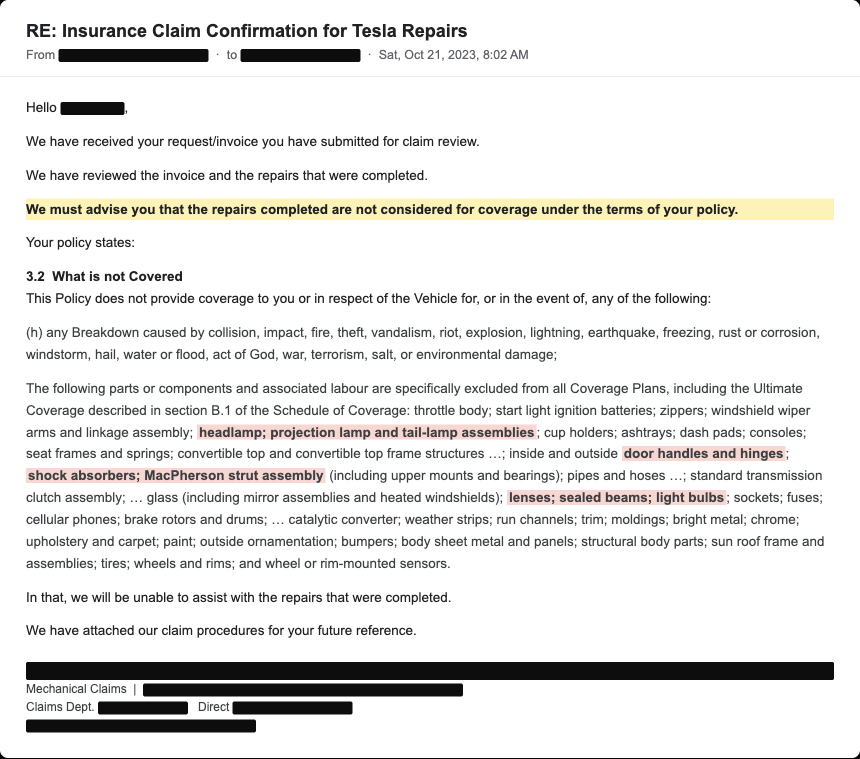
The actual denial (insurer and personal details redacted). The plan’s §3.2 exclusions list is where it quietly rules out the four-figure, generation-typical items — headlights, suspension struts — that an aging Model X is most likely to need.
I’m not saying every one of these products is worthless — mine did pay for some things. But treat the exclusions list as the real contract, because that’s exactly what it is: it’s where the plan tells you, up front, which repairs it won’t cover — and on these cars, that tends to be the ones most likely to happen. The deeper lesson is the one this whole article is built on: the most reliable diligence is the one you do yourself, before you buy. Tesla won’t inspect the car for you. An after-market plan may or may not catch you when you fall — and you find out which only after it’s too late to change your mind. What’s actually in your control is knowing the car’s true condition going in.
The bottom line
Tesla won’t inspect a car you don’t own — but that doesn’t leave you blind. A good EV shop reads the physical car; a DIY OBD scan reads the raw data if you speak the language; and a data-based inspection reads that same data and hands you a plain, validated verdict you can act on. On a purchase where a single hidden problem can cost more than the inspection a hundred times over, the wrong move isn’t picking one of these — it’s skipping all three.
Prices are typical US/Canada figures, 2026; owner accounts of Tesla declining non-owner inspections are linked inline. Our own inspection report is in beta — read-only OBD-II, no Tesla account, one-business-day reply.