Two owners of the same car, same year, same spec:
“I have 42k miles on my 2017 X and in the last 6 months have paid about $4,000 in repairs… Car is turning into a pumpkin with such low miles.” — r/TeslaLounge
“Our 2017 with 125k on it has been perfect. Tires only.” — r/TeslaModelX
Both are telling the truth. A used Model S or X is not one gamble — it’s a stack of small, checkable facts, and almost every expensive surprise in the first story was visible before purchase if you knew where to look.
I own a 2017 Model X 100D, bought used. I’ve been through the suspension bill, the warranty-deadline battery replacement, and the service-center second-quote dance. This checklist is what I wish I’d had. It is not my opinion: every item below appears in multiple independent owner threads on Reddit or Tesla Motors Club, in Tesla’s official warranty terms, or in established repair guides. Where something comes from a single credible source, I say so. Sources are linked throughout, and the condensed 20-point table is at the end.
Do the homework before you see the car
The warranty math nobody puts in the listing
This is the single highest-leverage fact in the used S/X market, and it hinges on build date, not model year:
- Built before ~February 2020: battery + drive unit covered 8 years, unlimited miles (fixyourtesla).
- Built later: 8 years / 150,000 miles, with 70% capacity retention guaranteed (Tesla official warranty terms).
- Bought from Tesla’s used inventory: you get 1 extra year / 10,000 miles after the basic warranty ends.
- The warranty follows the car. The old forum claim that a third-party purchase voids the remainder is outdated — Tesla’s current warranty page says otherwise.
Owners exploit this deliberately. One buyer picked a 2019 X 100D with 110,000 miles because the unlimited-mileage powertrain warranty ran to 2027 — seven months later the HV battery was replaced free. Free pack replacements at 55k–110k miles under this warranty are documented repeatedly.
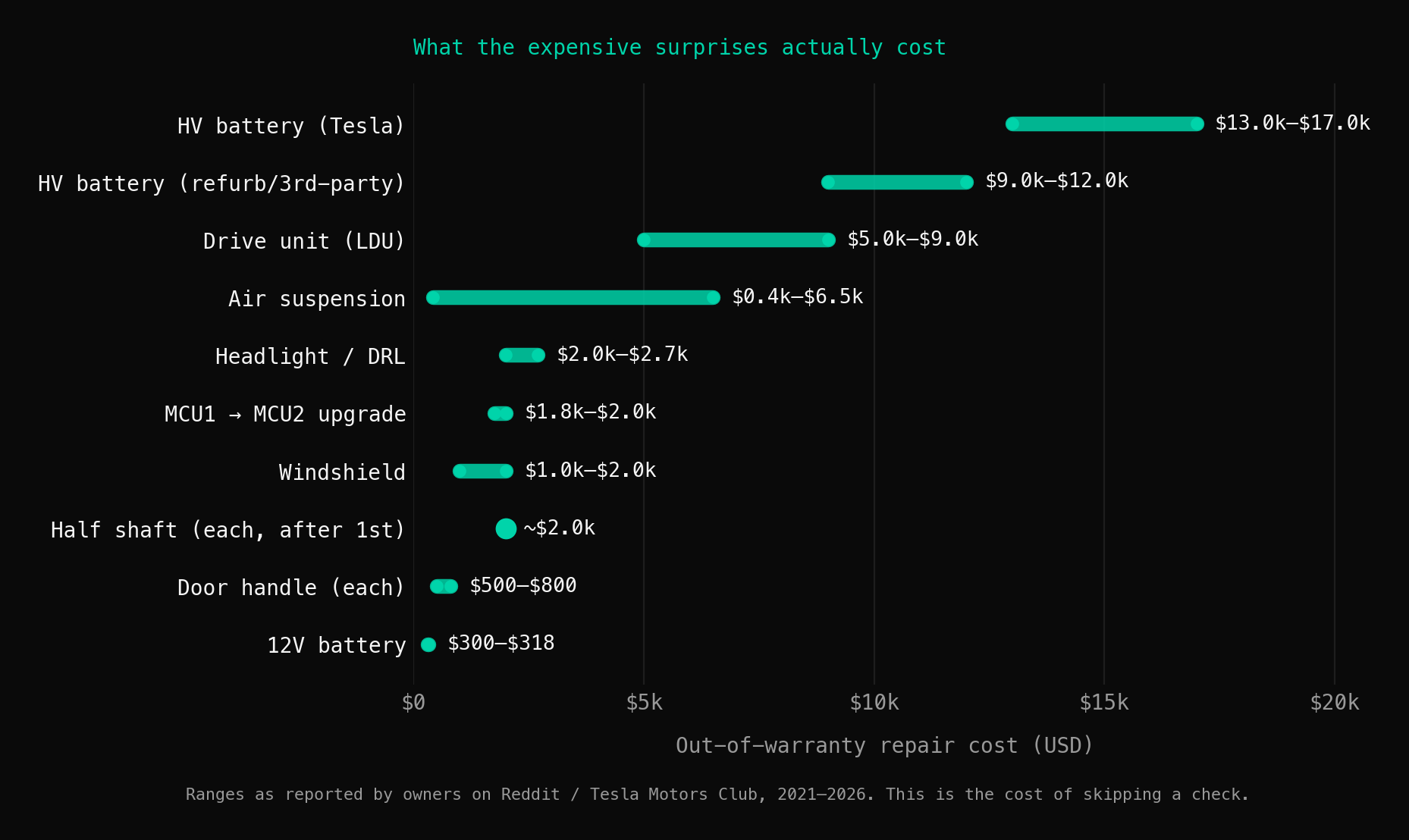
The flip side: an out-of-warranty pack failure is a $13,000–$17,000 Tesla quote, or $9,000–$12,000 refurbished (267-comment thread, FindMyElectric). My own pack died two months before the warranty ran out. Two months later, that’s a $15k+ invoice. When you shop, compute the exact months and miles of battery coverage remaining — it is worth real money.
The year and config risk map
Consensus across the buying threads (1sslnwt, 1iqakj9, 1sdls7c, kmcelectric):
| Era | Risk level | Why |
|---|---|---|
| 2012–2016 S | Highest | Original large drive unit (LDU), 85 kWh pack failure rates, MCU1, gen-1 door handles |
| 2016–2018 S/X | Moderate | MCU1 until ~March 2018, air-spring age, screen delamination era |
| Raven (mid-2019–2020) | Lowest pre-refresh | Better suspension + efficiency, Model-3-derived front motor, often still under battery warranty |
| 2021+ refresh | Low | New architecture, no legacy handles — “substantially more reliable” per owners |
One caveat worth knowing, from an independent EV mechanic (saabstory88’s much-cited comment): 2019-built 100 kWh packs have a voltage-sense harness failure mode that Tesla addresses only with full pack replacement. Single expert source — treat it as a reason to scrutinize battery data on 2019 builds, not as a verdict.
Also decide your FSD stance now: only Oct–Dec 2023+ Model X builds have HW4. “Full Self-Driving: Included package” shown on the car’s own screen stays with the car; a subscription doesn’t, and the FSD transfer program ended March 31, 2026. Verify on the screen, never from the listing (verification thread).
The battery: four ways to check, in increasing depth
Method 1 — the 100% test. Charge to full, read rated miles, compare against the original EPA rating for that configuration and wheel size. The wheel-size part matters: a 2022 X Plaid showing 273 miles at 99% looked degraded 30% against the headline 348-mile rating — but on its 22" wheels the correct baseline was ~315–330, i.e. the pack was fine.
Method 2 — no full charge needed. Toggle the display between % and miles, divide, and project to 100%. Thirty seconds during a viewing (the mi/% trick).
Method 3 — Tesla’s own test. Service tab → battery health test. It’s real diagnostics, but it can hold the car for up to ~16 hours and works best started near-empty — realistic only if the seller runs it before you arrive (protocol details). One buyer’s used car tested 98% at 45k miles — the community’s read: that pack had almost certainly been replaced already, which the service records then confirm.
Method 4 — read the BMS yourself. A $40 OBD adapter plus ScanMyTesla shows what the car actually knows: usable capacity, state of health, and per-cell voltages. The published rules of thumb — SoH >88% acceptable, >92% great, cell spread under 20 mV healthy, over 50 mV = weak cell group — come from tesladiyrepair, and they match what I see logging my own 100D’s pack continuously: a healthy pack holds a tight, boring cell spread. This is the method that catches what a test drive can’t.
Normal degradation for context: ~5–10% in the first couple of years, then 1–2% per year. And expect real-world highway range to undercut rated range — a healthy 2017 X 100D rated 295 delivers about 220 highway miles at 70 mph. That’s physics, not a defect.
Drivetrain: the LDU question and the half-shaft click
Pre-2016 S (RWD and all Performance trims): ask about the large drive unit. It has a well-documented coolant-ingress failure pattern — the famous $7,000-then-$7,900-again saga (1,800 upvotes) features a commenter identifying as Tesla staff confirming “we have an internal document on this exact issue.” During inspection: coolant residue on the motor speed sensor is the early warning (r/TeslaModelS). A replaced drive unit or a coolant-delete mod is good news, not bad.
AWD S/X: listen for the half-shaft click. Hard acceleration from a stop, wheel slightly turned — clicking or shuddering means the half shafts are going, a known geometry issue. Service bulletin SB-21-39-001 gets you one discounted (~$300) replacement out of warranty; after that it’s ~$2,000 a time. If the seller has the bulletin work documented, that’s a plus; if the car clicks and they haven’t used the bulletin, that’s your negotiation item.
Air suspension: the 15-second corner test
With the car on, cycle through every ride height, then watch each corner: it should reach height and settle within 10–15 seconds and stay there. Corner sag overnight, a compressor that runs every time you walk past, or one corner sitting low are all leak symptoms (tesladiyrepair, kmcelectric).
Why it matters: repair costs span an absurd range — a $425 valve block if you catch it early, $2,500–$6,500 once spring modules and compressor go together. My own suspension bill was $6,000 CAD, and the leak that started it didn’t show up as a dropped corner until weeks after the impact that caused it. Slow leaks hide; compressor behavior gives them away first. (This is the exact reason our monitoring watches compressor duty cycle — more on that below.)
While you’re under there: control arms are a “when, not if” wear item on the X — listen for clunks and creaks over bumps on the test drive (1sdls7c).
MCU and screens: know which computer you’re buying
- MCU1 (2012 – ~March 2018): slow today, and its eMMC flash chip wears out — frozen screens, spontaneous reboots, black display. The upgrade to MCU2 runs $1,750–$2,000 and owners near-universally call it worth it (“made my car feel new again”). If the car has MCU1, price the upgrade into your offer.
- Spot MCU2 in the field: repeater-camera views appear on screen in reverse; check the About screen to be sure (field guide).
- Screens themselves: yellow border (cheap UV fix), adhesive ooze, bubbles (needs replacement) — endemic on 2016–2018 cars (TMC buyer’s guide).
Model X only: the falcon-door protocol
The doors are the X’s signature risk, so test them like you mean it (1taq8po, fixyourtesla):
- Full open/close cycles from the touchscreen, the pillar button, and the handle — several times each side.
- Stand outside and listen: clicking, grinding, metal-on-metal.
- Watch for phantom obstruction stops (the chronic sensor failure — one owner’s car went through seven repair attempts and a buyback).
- Check the sills for paint rub (common, cosmetic, PPF fixes it) and the roof seals for wear — hose-test if the seller allows.
- A hinge failing outright is rare but documented.
Perspective from the cost data: plenty of door fixes are $100–$250 sensor/trim jobs. It’s the pattern of repeated failures you’re screening for.
Seat trivia that changes daily life: the 6/7-seat X has two AC units, the 5-seat has one; only post-July-2017 7-seaters fold flat (fixyourtesla).
Model S only: cycle every door handle
The presenting handles are “the single most reported mechanical fault on pre-facelift Model S.” Cycle each one several times — cold weather exposes weak ones best. $500–$800 per handle at Tesla, and long-term owners have replaced all four. Gen-3 handles (mid/late-2017 onward) are much better.
Body, water, and the underside
- Water: check carpets, cubbies, and headliner for stains; sunroof drains clog, rear hatches leak, X roof seals wear (TMC buyer’s guide).
- Panel gaps and repaint tell you about accident history faster than paperwork does.
- Look under the car at the battery pack for dents (TMC guide) — skid damage to the pack is the expensive kind of invisible.
- Carfax is necessary, not sufficient: claims take 4–6 months to appear, and one buyer’s clean-Carfax Plaid from Tesla’s own inventory later surfaced rear and side impact records.
Tires: read the inner edges
S/X rear camber eats inner tread edges — invisible unless you crouch or reach in. Uneven inner wear means tires soon ($350–$400 each) and possibly alignment/camber work. Two leverage points: Tesla’s own used-vehicle standard is ≥5/32 tread, which one buyer used to get free replacement tires; and the aftermarket fix (adjustable camber arms) is what finally makes rear tires last (owner data).
The 12V battery: just replace it
A dead 12V strands the car regardless of how healthy the big pack is, usually without warning. If it’s 3+ years old, budget the ~$300 replacement into your first month (real invoice: $318). It’s the cheapest insurance on this list.
Paperwork: three things sellers don’t volunteer
- Service history must come from the seller, before the sale. Tesla will not show a new owner the previous owner’s service records — the seller exports PDFs from their app (18-point comment, fixyourtesla). What you’re looking for: battery or drive-unit replacements (good news!), MCU work, suspension jobs, the half-shaft bulletin.
- Verify every option on the car’s screen, not the listing: trim, FSD “Included package,” free unlimited Supercharging (some cars lost it on resale), Premium Connectivity.
- Lemon buybacks: Tesla sells them and won’t tell you what the defect was (documented). Title check catches the branding.
The test drive: 30 minutes, not 5
A rushed 5-minute check famously missed a broken rear defroster and a coolant warning (TMC delivery story). Minimum protocol:
- Hands-light straight-line at highway speed (pull = alignment)
- Hard brake from ~40 mph (pulsation, pull)
- Rough pavement (clunks = control arms/links)
- Tight slow turns + hard launch (half-shaft click)
- Regen feel, no “reduced power” or thermal warnings
- Cabin electronics sweep: every window, defroster, HVAC on both sides, cameras
Before money changes hands: charge the car. AC at minimum, a Supercharger if at all possible. A “beautiful” CPO that turned out unable to charge at home is a real story. Check Controls → Service for stored alerts, and confirm the mobile connector/adapters are actually included (cars delivered after April 2022 don’t include one by default).
Negotiation notes
- Comp the price against the broader market first — a 155k-mile 2018 75D listed at $28.8k drew a consensus “should be $18–22k,” and Carvana offered the same-spec owner $8,700.
- Tesla’s used inventory auto-drops prices on cars that sit; S/X average about 7 days — patience is a strategy.
- Every finding above is a line item: MCU1 (−$2,000), tires at the wear bars (−$1,400), half shafts clicking with bulletin unused (−$300 to −$2,000), 12V age (−$300).
The 20-point checklist
| # | Check | Red flag costs |
|---|---|---|
| 1 | Battery: 100% range vs EPA for that config/wheels | Pack $13k–17k OOW |
| 2 | Battery: OBD SoH >88%, cell spread <20 mV | Weak cells → pack risk |
| 3 | Warranty months/miles remaining by build date | Pre-2/2020 = unlimited miles |
| 4 | MCU2 present (repeater cams in reverse / About screen) | MCU1 upgrade $1,750–2,000 |
| 5 | Screen yellow ring / bubbles / ooze | $30 fix → full replacement |
| 6 | LDU history (pre-2016 S): coolant at speed sensor | $4k–8k |
| 7 | Half-shaft click on hard launch; SB-21-39-001 status | $300 once, then ~$2k |
| 8 | Air suspension: cycle heights, corners settle in 10–15 s | $425 → $6,500 |
| 9 | Control-arm clunks over bumps | ~$1,200–1,500 |
| 10 | 12V battery age (3+ yrs = replace) | ~$300; stranding |
| 11 | X: falcon doors — full protocol, listen outside | $250/sensor → chronic |
| 12 | X: roof/door seals, sill paint rub | Leaks, cosmetic |
| 13 | S: cycle all door handles (cold if possible) | $500–800 each |
| 14 | Water stains: carpets, cubbies, headliner, hatch | Leak chase |
| 15 | Underside: battery-pack dents | Pack damage |
| 16 | Tires: inner-edge wear; ≥5/32 if from Tesla | $1,400+/set + alignment |
| 17 | Service history PDFs from seller before sale | Blind purchase |
| 18 | Config on screen: FSD “Included,” Supercharging, connectivity | Paid features missing |
| 19 | Title/Carfax + 4–6-month lag awareness; lemon branding | Hidden accident |
| 20 | 30-min test drive + charging test (AC + DC) + stored alerts | Everything above |
What a checklist can’t see
Everything above is what a careful buyer can verify in a driveway. It’s most of the risk. But three things live only in the car’s data history:
- How the battery was actually used — my car’s previous owner supercharged almost exclusively. The pack degraded early and was replaced under warranty two months before the deadline. Nothing on a test drive would have shown that; the BMS data made the case.
- Whether high-voltage isolation is healthy — the safety metric behind leak/shock risk. My car broadcasts ~790,000 isolation readings a day; a healthy pack holds a flat, boring line.
- Where the suspension trend is heading — leak rates and compressor duty cycle show degradation weeks before a corner visibly sags.
That’s the gap our pre-purchase inspection fills: a read-only OBD scan of the car’s own data, delivered as an evidence report you can take into the negotiation — battery health with cell-level detail, charging-behavior history, isolation, suspension trend. No Tesla account needed, and it doesn’t void anything.
If you’re earlier in the process, start with the checklist above — it’s free and it catches most of the expensive surprises. And if a seller won’t let you check something on this list, that tells you something too.
Method note: items in this guide were compiled from ~25 owner threads across r/TeslaModelS, r/TeslaModelX, r/TeslaLounge and Tesla Motors Club, plus Tesla’s official warranty page and four established repair guides — and only kept when confirmed by multiple independent sources. Single-source claims are attributed inline. Prices are US dollars except where noted, as reported by the linked owners, 2021–2026; treat them as ranges, not quotes.